
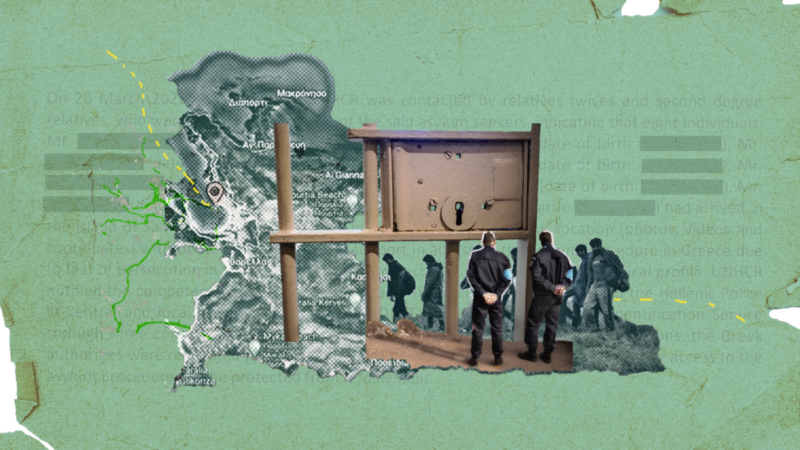
On 9 July 2025, Refugee Support Aegean (RSA) released a detailed report describing the lack of any first‑reception and accommodation structures for refugees arriving in Crete, at a time when the island was experiencing a sharp increase in arrivals.
RSA reported:
“Newly arrived refugees in Crete and Gavdos continue to reside in temporary, informal, and unsuitable spaces in Crete, under unacceptable and undignified conditions and without basic infrastructure. The situation at the end of June was characteristic, when hundreds of refugees arrived on large vessels at various points on the island. There were reports of people departing even barefoot towards the organised structures of the mainland.In Rethymno, the 501 people who arrived on 21 June in Agia Galini were transferred to an open field with tents in the Tsesme area, where they were subjected to a racist attack with flares by a gathered crowd. They were then transferred to another unsuitable location, the old Kitrenosi facilities in Latzima. In Chania, at the temporary accommodation facility in the former Agyia exhibition center, conditions remain undignified, despite strong criticism, while only a few days ago a few makeshift showers were installed. In Heraklion, new arrivals are staying in the so-called old ‘Psygeio’ (Fridge)- ITHAVIK rooms at the port. These are rooms of 15 sq.m. that lack water, natural light, or adequate ventilation, with the Union of Coast Guard Personnel of Crete warning of a health-bomb. Organisations and citizens’ collectivities periodically conduct campaigns for the collection of basic necessities and clothing, which they distribute to the refugees in the aforementioned spaces.”(Links from original source text)
RSA also noted that Greek authorities failed to implement the legal framework governing the reception and identification of asylum seekers — specifically Law 4939/2022 (Government Gazette A’ 111-10/06/2022)), which incorporates into Greek law the rules on reception and international protection for third‑country nationals and stateless persons, as well as temporary protection in cases of mass influx:
“In any case, it is clear that the authorities are failing to implement the explicit provisions of the law, which dictates that newly arrived refugees, immediately upon their arrival and under the responsibility of the police or coast guard authorities, must undergo reception and identification procedures. In Crete, no service of the competent Reception and Identification Service (Reception and Identification Center) operates, nor has any mobile unit been provided to carry out the absolutely necessary and urgent procedures for new arrivals. The lack of first reception procedures leads to a failure in identification and poses serious risks for vulnerable individuals, such as, for example, unaccompanied minors and those facing serious medical issues requiring immediate attention. Furthermore, the appalling conditions in detention centers in Libya, where refugees are often victims of torture, inhumane and degrading treatment, or even mass rapes, make large segments of newly arrived refugees particularly vulnerable.”
RSA also referred to the illegal nature of efforts by Greek authorities to prevent refugee arrivals by removing boats from Greek territorial waters before they reached the country’s shores:

“…after the arrival of numerous refugee vessels from the coasts of Libya in mid-June, the government decided to send two Greek frigates and a general support vessel to the maritime area south of Crete up to the limits of Libya’s territorial waters with the aim of their presence acting as a “deterrent.” According to local media, this operation has already begun, and the two frigates were spotted sailing south of Sfakia on 29 June.
We reiterate that informal forced returns (pushbacks and any other form of forced removal) of third-country nationals are absolutely illegal under international, European, and national law. These practices have already led to condemnations of Greece by the European Court of Human Rights (ECHR).
Therefore, the only lawful action authorities can take is the rescue of individuals in distress at sea and ensuring their access to the right to raise any protection issues (asylum) by explaining their individual circumstances, and not their obstruction.”
These facts raise a serious issue of non‑compliance – on the part of the Greek authorities – with the country’s international obligations regarding the reception, care, and dignified living conditions of refugees.
More specifically, beyond the aforementioned Law 4939/2022 on the reception and international protection of third‑country nationals and stateless persons, the 1951 Convention Relating to the Status of Refugees (Geneva Convention) – which recognizes the right to asylum – guarantees a series of rights for refugees in their country of residence, including, among others:
The Geneva Convention also prohibits the expulsion or refoulement of refugees (Article 33).
Under the rule of law, authorities are obliged to respect the rights of refugees during their reception and care.
However, the evidence in this case indicates serious shortcomings, failures, and unlawful actions by the Greek authorities in the reception of individuals entitled to international protection in our country, even though their rights are safeguarded by the 1951 Convention Relating to the Status of Refugees (Geneva Convention) and by Law 4939/2022 on the reception and international protection of third‑country nationals and stateless persons.






Bank Account number: 1100 0232 0016 560
IBAN: GR56 0140 1100 1100 0232 0016 560
BIC: CRBAGRAA

In a time where the very foundations of democracy are gradually being eroded by the rise of extreme nationalism, alt-right movements, the spread of disinformation and corporate capture, the efforts of organisations such as Vouliwatch are more relevant than ever.
We rely on the generosity of each and every one of you to continue with our efforts for more transparency and accounta
By financially supporting Vouliwatch you support our litigation strategy, our campaigns for transparency and accountability in the political system, the development of new civic tech tools, our research projects and last but not least our impartial and accurate