
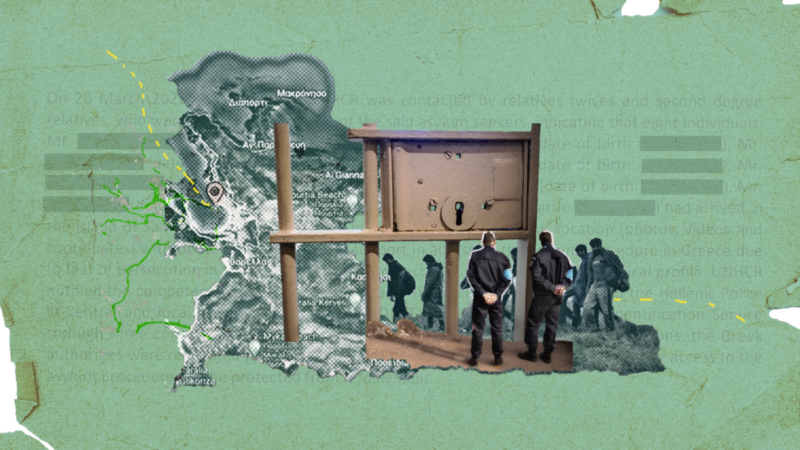
On 30 January 2025, the organization Refugee Support Aegean – RSA published an extensive analysis providing evidence and documentation regarding the “non‑existent infrastructure for the reception and accommodation” of refugees in Crete and Gavdos.
The RSA publication highlighted, first and foremost, that government commitments to establish appropriate and organized reception and accommodation facilities for asylum seekers on the two islands were never implemented. As a result, newly arrived individuals have been left in “informal and unsuitable spaces” in Crete.
RSA explained that the majority of newly arrived refugees in the Chania region in recent months—including survivors of the shipwreck of 13 December 2024—have been transferred to the exhibition hall in Agia, Chania. According to repeated complaints, this facility lacks even the most basic provisions for dignified accommodation, let alone for people who have survived shipwrecks. During the previous spring and summer of 2024, arrivals were instead taken to the outdoor parking area of the Central Port Authority of Chania in Souda, another unsuitable location.
The organization also cited complaints from local groups regarding the inadequate infrastructure and shortages in the provision of essential items to refugees.
RSA reported that the Social Centre – Migrant Centre of Chania has denounced the temporary accommodation conditions at the Agia exhibition hall in Chania, stressing that the facility lacks basic necessities and heating. According to the organization, newly arrived refugees are forced to sleep on the floor with thin mats, improvised bedding, and insufficient blankets that are reused. Many move around barefoot or wearing plastic sandals, without socks, shoes, or clothing suitable for the season. In earlier statements, the Centre had also highlighted that residents were not even provided with soap and had no access to showers.

RSA noted that similar conditions prevailed in Heraklion, where newly arrived refugees were until recently transferred to and housed in the building of the “old bus station,” a site deemed clearly unsuitable. The Deputy Mayor for Social Policy of Heraklion, Georgios Tsagkarakis, had also confirmed to RSA in a telephone conversation on 17 January 2025 that two sites used more recently were indeed unsuitable. He explained, however, that the municipality had no alternative facilities available, and that responsibility for accommodation had been assigned to the Coast Guard.
RSA further noted that Tsagkarakis confirmed that—just as in Chania—the municipality had received no information from the Ministry regarding the creation of temporary reception facilities, despite earlier announcements. He explained that the municipality provides medicines and clothing when available, while the Region of Crete supplies food and buses for transportation. First aid and medical care are delivered by the Red Cross and a team of doctors.
According to complaints from the solidarity group Thalassa Allileggyis, refugees accommodated in Heraklion facilities had no access to showers, and mattresses and blankets were reused. In a statement issued last August, the same group reported that newly arrived individuals transferred to the building were left barefoot and were given plastic bags to cover their feet.
These findings raise serious concerns about the failure of the Greek authorities to respect the country’s international obligations regarding the reception, care, and dignified living conditions of refugees.
More specifically, the 1951 Convention Relating to the Status of Refugees (Geneva Convention), by recognizing the right to asylum, guarantees a series of rights for refugees in their country of residence, including: the right to movable and immovable property (Article 13), the right of association (Article 15), the right of access to courts (Article 16), the right to work (Articles 17–19), the right to social welfare (Article 20), housing (Article 21), and public education (Article 22), as well as freedom of movement (Article 26). In addition, the Geneva Convention prohibits the expulsion or refoulement of refugees (Article 33).
In a state governed by the rule of law, authorities are obliged to respect the rights of refugees during their reception and care.
However, the evidence in the case under examination reveals serious shortcomings and failures on the part of the Greek authorities in the reception of individuals entitled to international protection in our country, despite the fact that their rights are safeguarded under the 1951 Convention Relating to the Status of Refugees (Geneva Convention).






Bank Account number: 1100 0232 0016 560
IBAN: GR56 0140 1100 1100 0232 0016 560
BIC: CRBAGRAA

In a time where the very foundations of democracy are gradually being eroded by the rise of extreme nationalism, alt-right movements, the spread of disinformation and corporate capture, the efforts of organisations such as Vouliwatch are more relevant than ever.
We rely on the generosity of each and every one of you to continue with our efforts for more transparency and accounta
By financially supporting Vouliwatch you support our litigation strategy, our campaigns for transparency and accountability in the political system, the development of new civic tech tools, our research projects and last but not least our impartial and accurate