EXTERNAL REPORTS

Corruption
Conflict of interests in the public sector & Revolving Doors
Public Procurement/Μisuse of Public Funds
Corruption Perceptions Index 2025
pdf
Europe must step up leadership in the fight against corruption . Despite ranking as the world’s least corrupt region, progress against corruption in Western Europe and the European Union (EU) has stalled over the past decade. The region’s average score in the 2025 Corruption Perceptions Index (CPI) has fallen from 66 to 64, with 13 countries seeing significant declines and only seven making improvements, underscoring a widening gap between anti-corruption standards, enforcement and the integrity of those in power.
As Europeans confront overlapping challenges, the demand for decisive leadership and robust, independent institutions has never been clearer. Instead, persistent failures of leadership and accountability are undermining integrity and accelerating the loss of public confidence in government.
In December 2025, the EU adopted its first Anti-Corruption Directive, intended to harmonise criminal laws across member states and establish a zero-tolerance approach. However, key provisions were weakened, as a result, the Directive’s final framework falls short on ambition, clarity, and enforceability, squandering an opportunity to take a collective stance against corruption. As EU member states prepare to transpose the Directive, they should treat it as a springboard, not a ceiling, for ambitious reform and enforcement.
At the same time, efforts to weaken anti-corruption rules and checks and balances, along with state attacks on civil society, independent media, and whistleblowers, are undermining the quality of democracy in the region by making abuses of power harder to detect and expose.
In Hungary (40), Viktor Orbán’s party used claims of promoting transparency to justify proposed powers to shut down critical NGOs and media, an effort that ultimately failed. In Slovakia (48), the government is dismantling anti-corruption safeguards, including whistleblower protections, and weakening investigations of corruption and organised crime, especially those involving senior officials. Instead of wielding the strong rule-of-law measures available to it, the EU has sat idly by as member states have dismantled democratic protections.
Elsewhere, significant decliners include the UK (70) and France (66). In the UK, the past decade has seen major domestic scandals, the awarding of favours and honours to political donors, and MPs working as lobbyists for paying clients and corrupt regimes. Even with some strong standards in France, enforcement challenges persist and there are growing risks of collusion between officials and private interests. Both countries and Spain (55), another significant decliner, have launched national anti‑corruption plans to address existing loopholes. However, for these to be effective, implementation will need to be ambitious, well‑funded, and carefully monitored.
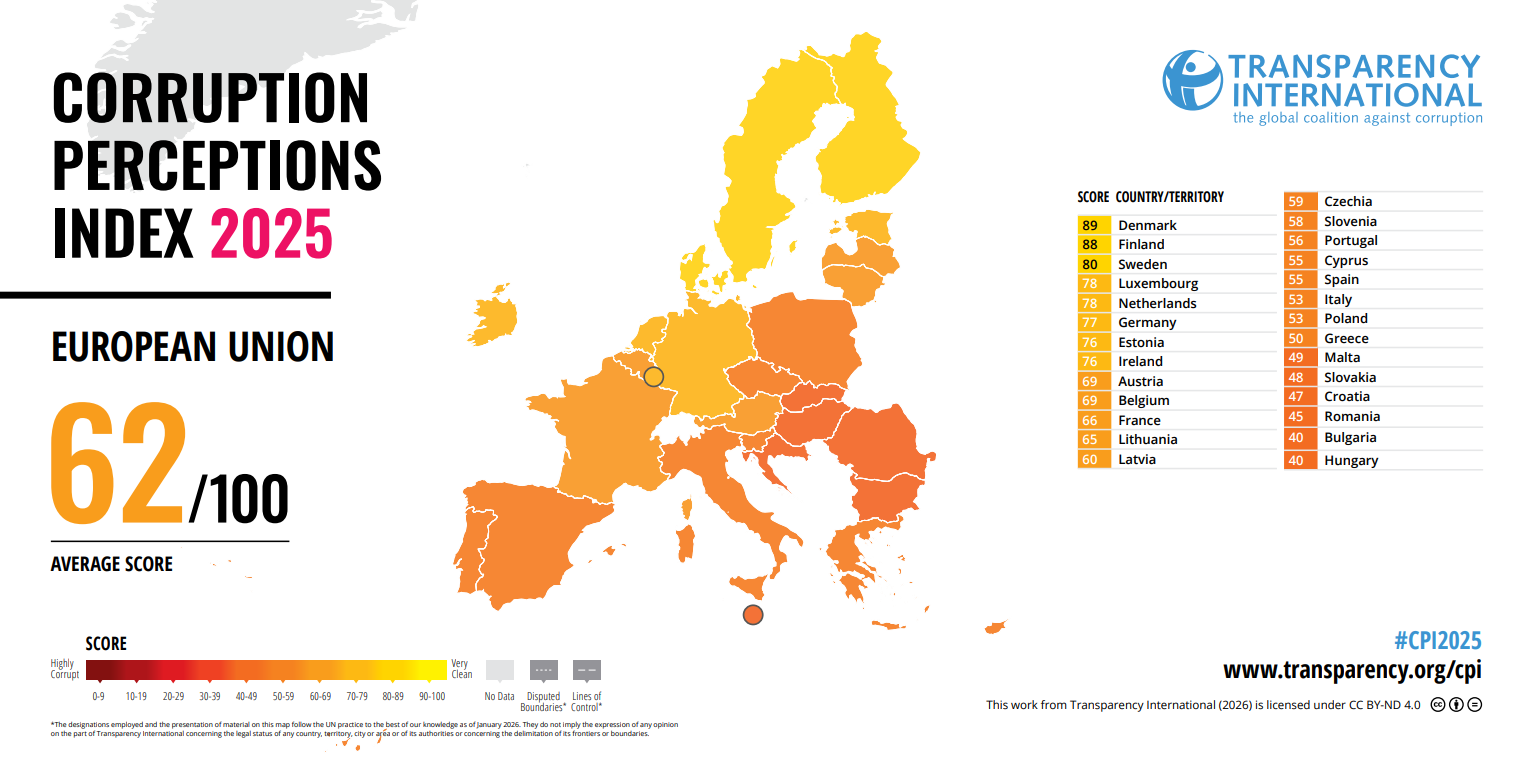
Flora Cresswell, Regional Advisor for Western Europe at Transparency International said:
“In the current geopolitical climate, Europe should be raising, not lowering, its anti-corruption ambitions. Corruption is not inevitable: Europe and its leaders must act now to show ambitious, enforceable reform and global leadership.”
The CPI ranks 182 countries and territories by their perceived levels of public sector corruption on a scale of zero (highly corrupt) to 100 (very clean).





Bank Account number: 1100 0232 0016 560
IBAN: GR56 0140 1100 1100 0232 0016 560
BIC: CRBAGRAA

In a time where the very foundations of democracy are gradually being eroded by the rise of extreme nationalism, alt-right movements, the spread of disinformation and corporate capture, the efforts of organisations such as Vouliwatch are more relevant than ever.
We rely on the generosity of each and every one of you to continue with our efforts for more transparency and accounta
By financially supporting Vouliwatch you support our litigation strategy, our campaigns for transparency and accountability in the political system, the development of new civic tech tools, our research projects and last but not least our impartial and accurate