
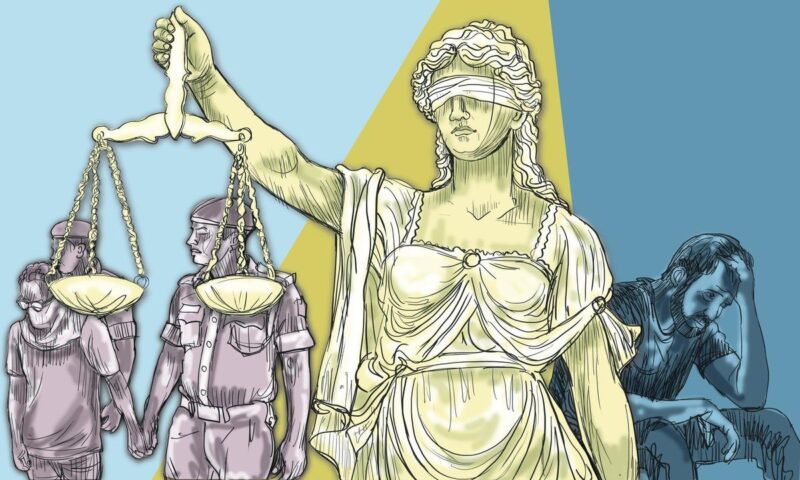
On February 4, 2025, the Ministry of Maritime Affairs and Island Policy issued a public statement following the Ombudsman’s report concerning the responsibilities of the Hellenic Coast Guard in the deadly shipwreck off Pylos.
In its statement the Ministry asserted, among other things, that the report objectively attempts to shift the discussion away from the criminal networks of smugglers and onto the officers of the Coast Guard, and that among various possible interpretations of the case’s factual elements, the report systematically sides with those claims that challenge the proper exercise of the Coast Guard’s duties, without any credible substantiation, ultimately relying upon conjecture.The Ministry further stated that the Independent Authority “reaches arbitrary conclusions that risk prejudicing judicial evaluation,” while also insinuating that the report contains “political content.”
The Ministry’s statement was condemned as an attack against the constitutionally enshrined Independent Authority of the Ombudsman (Article 103(9) of the Constitution: “Law shall specify matters relating to the establishment and activities of the “Ombudsman”, who functions as an independent authority.”).
The National Commission for Human Rights (NCHR), which serves as the independent advisory body of the Greek state on human rights issues, issued a detailed statement regarding the Ministry’s position. In it, the Commission called upon the state to respect the constitutionally enshrined role of Independent Authorities, ‘refraining from direct interventions in the exercise of their oversight powers as safeguarded by the Constitution and its implementing laws.’
The statement voiced strong concern over the Ministry’s assertion that the Ombudsman’s investigation into the Pylos shipwreck was politically motivated, which thereby disregarded his institutional role as the National Mechanism for the Investigation of Incidents of Arbitrary Conduct.
The NCHR also highlighted that the Ministry’s questioning of the legality of the investigation on the grounds that the Ombudsman’s term had expired, runs counter to Article 101A of the Constitution, which explicitly provides that the term of members of independent authorities is extended until new appointments are made.
In the Commission’s assessment, such an attack against an Independent Authority, especially in relation to the exercise of its constitutionally and legally defined powers, amounts to a direct challenge to the institutional role guaranteed by the Constitution. It emphasized that respect for the independence of these authorities and their ability to function without interference from the executive is a fundamental requirement of the rule of law.

Beyond the constitutional recognition of the Ombudsman as an Independent Authority, it is important to note that his competence as the National Mechanism for the Investigation of Incidents of Arbitrary Conduct is established by Article 1 of Law 3938/2011 (Official Gazette A’ 61/31.03.2011), as subsequently amended by Article 56 of Law 4443/2016 (Official Gazette A’ 232/9.12.2016) and Article 188 of Law 4662/2020 (Official Gazette A’ 27/07.02.2020).
Under this framework, the Ombudsman is entrusted with responsibilities that include collecting, recording, assessing, investigating, and, where appropriate, forwarding for disciplinary review complaints concerning acts, omissions, or conduct by uniformed personnel of the Hellenic Police, the Hellenic Coast Guard, the Fire Service, as well as employees of detention facilities. These responsibilities apply to incidents occurring in the course of duty or through abuse of official capacity, and cover serious violations such as torture and other affronts to human dignity, unlawful intentional attacks against life, physical integrity, health, or personal and sexual freedom, unlawful use of firearms, and discriminatory behavior motivated by racism or other forms of unequal treatment based on race, color, ethnic origin, ancestry, religion or belief, disability or chronic illness, age, family or social status, sexual orientation, gender identity, or gender characteristics.
The Hellenic League for Human Rights (HLHR) also issued a statement condemning the Ministry of Maritime Affairs. The League argued that the Ministry’s announcement revealed a fundamental misunderstanding of the Ombudsman’s role, not only by the minister and his staff but also by other government officials who have adopted similar positions.
According to HLHR, instead of acknowledging its position as the body under scrutiny, the Ministry engaged in an unprecedented public denigration of the work of the Independent Authority charged with oversight. The statement noted that the Ministry’s stance included personal attacks against the Ombudsman himself and displayed a one‑sided defense of the Coast Guard.
The League emphasized that constitutionally enshrined Independent Authorities are pillars of democratic constitutional order and safeguards of fundamental rights. It stressed that any attack on such authorities while they are exercising their lawful powers constitutes a direct challenge to constitutional order, and that attacks against the individuals serving within these authorities are equally unacceptable.
The Association of Employees at the Ombudsman’s Office issued a statement expressing strong concern and categorical opposition to the attacks directed against the Independent Authority in relation to its recent report on the deadly Pylos shipwreck. The Association stressed that the Ministry of Maritime Affairs’ announcement amounted to a direct assault on the work of Independent Authorities.
It further noted that the unprecedented public statements and announcements by state bodies such as the Ministry of Maritime Affairs went beyond criticism of the report’s content, targeting instead the institutional standing, independence, and credibility of the Authority itself. According to the Association, such interventions undermine the fundamental principle of the rule of law, which requires all public powers to act strictly within the limits set by law.
In the case under examination, however, the Ministry of Maritime Affairs launched an attack against the Ombudsman precisely while he was exercising his lawful oversight mandate – specifically after conducting an investigation and issuing a report on the responsibilities of the Hellenic Coast Guard in the deadly Pylos shipwreck.
Such administrative conduct runs counter to the constitutional recognition of the Ombudsman as an Independent Authority (Article 103(9) of the Constitution) and his institutional designation as the National Mechanism for the Investigation of Incidents of Arbitrary Conduct (Article 1 of Law 3938/2011).







Bank Account number: 1100 0232 0016 560
IBAN: GR56 0140 1100 1100 0232 0016 560
BIC: CRBAGRAA

In a time where the very foundations of democracy are gradually being eroded by the rise of extreme nationalism, alt-right movements, the spread of disinformation and corporate capture, the efforts of organisations such as Vouliwatch are more relevant than ever.
We rely on the generosity of each and every one of you to continue with our efforts for more transparency and accounta
By financially supporting Vouliwatch you support our litigation strategy, our campaigns for transparency and accountability in the political system, the development of new civic tech tools, our research projects and last but not least our impartial and accurate