
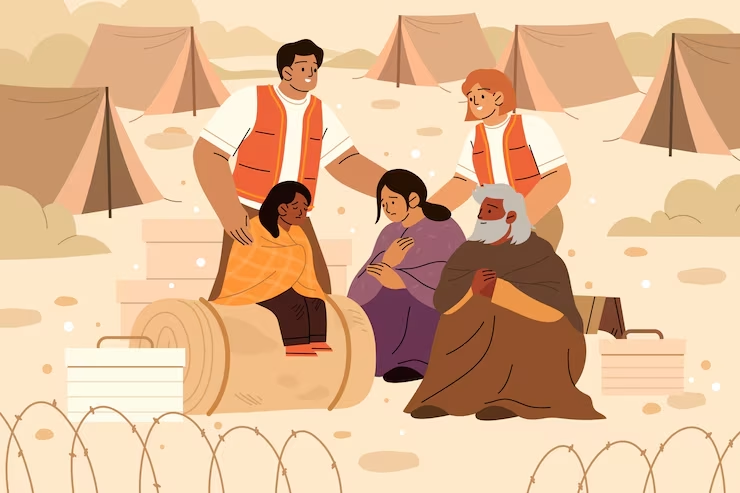
On 5 June 2025, international and domestic organisations issued a joint statement regarding the problematic and insufficient protection of refugees’ rights — particularly their right to housing — by the actions of the Greek authorities. (The full statement is available in Greek and English here.)
The organisations stated, “Ιn early May, Greek media reported that the Ministry of Migration and Asylum issued a verbal directive to the authorities of refugee camps across Greece to evict beneficiaries of International Protection as well as rejected asylum seekers from their facilities.The notice of the decision did not include guidance on appropriate alternative accommodation solutions or safeguards to avoid people falling into destitution. Compounded by long-standing issues accessing state support outside of camp facilities as well as the diminishing capacity of civil society to fill protection gaps, the decision risks placing various groups of people into precarious situations at odds with the fulfilment of their fundamental rights as well as respect for human dignity.” The organisations signing the statement included the Greek Council for Refugees (GCR), HIAS Greece, and Médecins Sans Frontières (MSF).
They continue, “While beneficiaries of International Protection are legally obliged to vacate state temporary camp-based accommodation 30 days after receiving a positive decision – a timeframe that is often not sufficient for the state administration to issue all the documents necessary for them to access alternative accommodation – integration support outside of the camps is limited. The Helios+ programme’s implementation began only recently, following the conclusion of its predecessor, and is currently in its early stages, with the application period opening on 26 May 2025. As a result, access to accommodation is not yet available. The programme is designed to serve a fraction of Greece’s refugee population, and will require sustainable funding to avoid the interruption of its services. Moreover, there are considerations with regard to its short-term nature, specific eligibility requirements and potential bureaucratic barriers. In addition, high risk of homelessness and destitution persist among beneficiaries of international protection, due to the gap that arises after 30 days from the issuance of a positive decision or discharge from a facility, until access to Helios housing becomes available.”
The statement also highlighted concerns regarding evictions, “Evictions are equally problematic when they do not take ongoing legal procedures into account, an issue which has been flagged by many applicants. This can be the case when applicants have appealed against rejection decisions in Greek Administrative Courts – with or without state funded legal aid – as procedures are riddled with extensive delays.”
The organisations concluded that remaining in the facilities is therefore, “the only possibility they have to avoid homelessness, informal employment and the accompanying risks of abuse, exploitation, trafficking, and extended detention.”
These facts raise concerns about Greece’s compliance with the country’s international obligations regarding the reception, care, and dignified living conditions of refugees, particularly in light of the recognition of their rights to housing and employment under both international and national law.
More specifically, beyond Law 4939/2022 on the reception and international protection of third‑country nationals and stateless persons, the 1951 Convention Relating to the Status of Refugees (Geneva Convention) — which recognizes the right to asylum — guarantees a series of rights for refugees in their country of residence, including, among others:
The Geneva Convention also prohibits the expulsion or refoulement of refugees (Article 33).
Under the rule of law, authorities must respect the rights of refugees during their reception, care, and period of stay in the country.
However, the evidence in this case indicates insufficient protection of their rights to housing and employment, despite these rights being guaranteed under Article 21 and Articles 17–19 of the Geneva Convention.






Bank Account number: 1100 0232 0016 560
IBAN: GR56 0140 1100 1100 0232 0016 560
BIC: CRBAGRAA

In a time where the very foundations of democracy are gradually being eroded by the rise of extreme nationalism, alt-right movements, the spread of disinformation and corporate capture, the efforts of organisations such as Vouliwatch are more relevant than ever.
We rely on the generosity of each and every one of you to continue with our efforts for more transparency and accounta
By financially supporting Vouliwatch you support our litigation strategy, our campaigns for transparency and accountability in the political system, the development of new civic tech tools, our research projects and last but not least our impartial and accurate
