
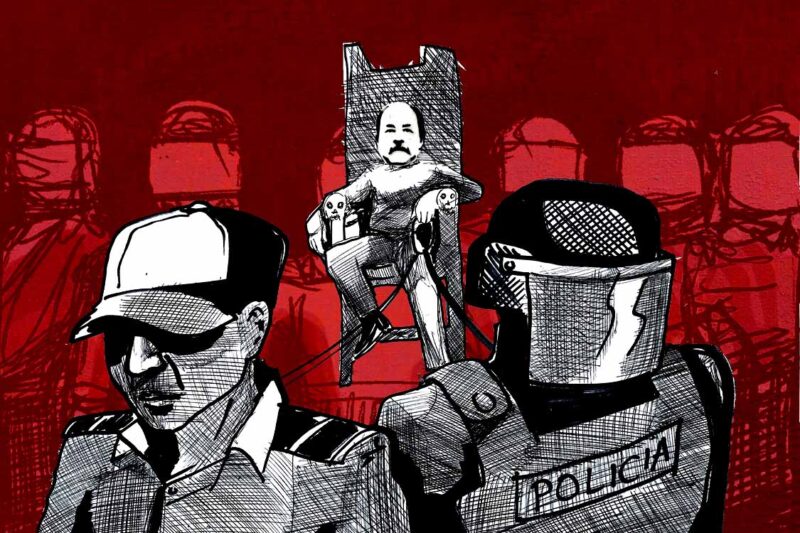
In April 2025, numerous articles and reports were published in the press concerning a complaint of excessive police violence against a 20‑year‑old citizen (indicatively: 1, 2, 3, 4, 5). It should be noted that the statement issued by the Hellenic Police (ELAS) and the allegations made by the victim’s side present very different versions of events.
More specifically, according to press reports citing information from ELAS, on 17 April 2025 officers of the police DIAS motorcycle unit attempted to stop a motorbike at the intersection of Tatoiou and Metamorfoseos streets in Kifisia. The driver, however, did not comply with their signals and tried to escape towards the area of Metamorfosi, making dangerous maneuvers and violating red lights, one‑way streets, and speed limits. During the pursuit, according to ELAS, the rider collided with a vehicle ahead and was arrested by the police for dangerous driving, disobedience, and driving without a license.
ELAS noted in its statement that the driver was not wearing a protective helmet and that through his dangerous driving he endangered other vehicle drivers and pedestrians. However, the allegations put forward by the family and the lawyer of the 20‑year‑old citizen present a completely different version of events.
On 27 April 2025, the victim’s father described to in.gr that his son had gone out for a ride on his own motorcycle, accompanied by a friend. During the outing, a DIAS patrol approached him in a threatening manner. Feeling intimidated, and aware that his licence only covered smaller‑engine motorcycles, the young man accelerated in an attempt to get away. As he headed towards the Kalyftaki exit, he was struck from behind, lost control, and collided with a car. According to the father, before his son could get up, a police officer hit him on the forehead with a radio device.
He further explained that the 20‑year‑old sustained serious injuries to his head and face, requiring stitches, and that his facial features were visibly deformed. The officer allegedly continued to assault him, striking his face repeatedly with the radio. When the young man tried to shield himself with his hands, he was handcuffed behind his back and the blows continued.
The victim’s father described the condition of his son upon his transfer to the hospital after the incident. He explained that when he arrived at the emergency department, he initially could not recognize his son because his face was so swollen and deformed; he eventually identified him only by his feet. According to the father, his son indicated that the injuries were the result of police violence rather than a traffic accident.
He recounted that he requested the presence of a forensic examiner but was told this was not possible. Fearing for his son’s survival, he asked for the doctor’s name to ensure there would be a witness to the fact that the injuries had been caused by police officers. The following morning, the young man was admitted to the intensive care unit, and his condition remained uncertain. Fortunately, on Easter Sunday he began to recover.
At present, the father stated, his son is suffering from cranio‑cerebral injuries. A forensic examination has been conducted, and the case has entered the judicial process, with the family intending to pursue legal action against the police officers involved.
The victim’s family disputes the account given by ELAS, which referred to a traffic accident prior to the arrest of the 20‑year‑old rider. They argue that the helmets worn by the young men showed no damage and that the motorcycle itself was retrieved intact from the police parking lot the following day, which they believe contradicts the claim of a serious crash.
According to the father, this condition of the vehicle and equipment makes it implausible that the extensive injuries sustained by his son were the result of a collision. The family’s lawyer further characterized the incident as an abuse of authority, describing the police officers involved as having acted in a manner akin to vigilantes. He emphasized that the assault was unprovoked, posed a risk to the young man’s life, and has already led the family to file complaints against all those involved.
The lawyer also criticized ELAS for downplaying the matter by focusing only on alleged traffic code violations, while ignoring the violence inflicted. He noted that the officers mocked the young man personally because of his motorcycle, and pointed out that the official case file does not include any charge of resistance to authority.
It should be noted that, although ELAS denied the allegations of “police violence” in relation to the incident, the force stated in its announcement that a preliminary and administrative investigation is being conducted, in line with standard practice in similar cases, in order to determine the validity of the claims concerning the conduct of the officers involved.
In a state governed by the rule of law, the actions and operations of the police authorities must be guided by certain principles, including the principle of legality, the principle of proportionality, the prohibition of abusive exercise of police powers, and the respect and protection of human rights.
The powers of the police authorities and the conduct they are required to demonstrate in the performance of their duties are regulated, among other things, by Presidential Decrees 538/1989, 141/1991, and 254/2004. Although the police are permitted to use force in order to enforce the law and protect human rights, this does not mean that any preventive or repressive use of force is lawful. On the contrary, arbitrary use of force or action beyond the legal limits constitutes a dangerous phenomenon for a democracy.
Taking the above into account, it must be emphasized that in this case a serious issue arises regarding compliance with the legislative framework that ensures the lawful functioning of ELAS officers. The concern is to prevent excessive and arbitrary violence against citizens — a matter that must be thoroughly investigated by the state authorities and the judiciary.







Bank Account number: 1100 0232 0016 560
IBAN: GR56 0140 1100 1100 0232 0016 560
BIC: CRBAGRAA

In a time where the very foundations of democracy are gradually being eroded by the rise of extreme nationalism, alt-right movements, the spread of disinformation and corporate capture, the efforts of organisations such as Vouliwatch are more relevant than ever.
We rely on the generosity of each and every one of you to continue with our efforts for more transparency and accounta
By financially supporting Vouliwatch you support our litigation strategy, our campaigns for transparency and accountability in the political system, the development of new civic tech tools, our research projects and last but not least our impartial and accurate
