EXTERNAL REPORTS

Council of Europe anti-torture Committee (CPT) again calls on Greece to improve its prisons
pdf
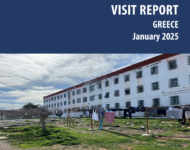
The report examines the treatment and detention conditions of persons held in seven prisons for men and two prisons for women, as well as several police facilities. The findings of the 2025 visit confirm once again that the structural issues of overcrowding and severe staff shortages, compounded by additional deficiencies in the prisons visited, continue to undermine the effective functioning of the prison system. The result is that many persons in prison are being held in poor and unsafe conditions.
Conditions of detention in male prisons continue to fall short of acceptable and legal minimum standards. Many detained persons are left to languish in overcrowded and wholly unsuitable conditions which could, in the CPT’s view, amount to inhuman and degrading treatment. Cells and dormitories often exceeded their intended occupancy, with single cells measuring 8 m2 accommodating up to five persons (Alikarnassos Prison), 11 vulnerable prisoners crammed into a filthy, 22 m2 cell (Nafplio Prison), certain dormitories offering less than 3 m2 of living space per person (Chalkida Prison), and dormitories measuring 25 m2 accommodating eight to 10 persons (Malandrino Prison). A lack of mattresses and blankets meant some prisoners had to sleep on concrete, or wet mattresses (Chania Prison). In most prisons, cells and dormitories were infested with bedbugs and cockroaches, often cold and damp or even mouldy, and had leaking roofs and ceilings (notably at Chania and Chalkida Prisons). Sanitary facilities were broken, and there was insufficient access to hot water or heating. Urgent improvements should focus on reducing cell occupancy, investing in maintenance, improving hygiene, and expanding the range of activities on offer to prisoners. Furthermore, prisoners placed in segregation or isolation should benefit from daily access to outdoor exercise and adequate supervision. The Committee also calls for a coherent strategy to reduce the prison population, which should prioritise alternatives to imprisonment and non-custodial measures.
Staffing levels were inadequate in all prisons visited, and dangerously low at Korydallos I and Chania Prisons, enabling stronger groups of prisoners to operate with impunity and allowing inter-prisoner violence to flourish in these and other establishments. The CPT calls for a national strategy to prevent inter-prisoner violence, prioritising increased staff numbers and comprehensive staff training and support. Furthermore, long-standing structural deficiencies in healthcare provision remained evident across all prisons visited, and were particularly alarming at Chania Prison. The CPT calls for substantial investment and a comprehensive reform of prison healthcare services, based on a needs assessment.
The report also assesses the situation of prisoners with disabilities, older prisoners, and transgender women, many of whom had unmet needs and lacked adequate support. The visit also focussed on women in prison with the CPT deploring the underuse of non-custodial alternatives to imprisonment and community-based responses for women, including pregnant women and mothers of young children. The Committee received several allegations of physical ill-treatment of detained women by male custodial staff, including a case involving degrading punishment of a woman who had self-harmed at Eleonas Women’s Prison, highlighting the need to reiterate a clear message of zero tolerance for ill-treatment, and to provide adequate staffing levels, and staff training for its prevention. Self-harm should not be punished with disciplinary sanctions, and restraints should not be used on women after such incidents.
Material conditions in certain wings of Eleonas Prison were extremely poor. Large dormitories should progressively be phased out and facilities repaired to ensure that all women are afforded a minimum standard of basic living conditions. Women in segregation at Korydallos II Prison should not be subjected to conditions akin to solitary confinement. The CPT also observed a chronic lack of staff, including custodial, specialised and healthcare staff. Detained women had poor access to healthcare services, which were inadequate, and the alarming lack of psychiatric care was illustrated by the deaths of two women at Korydallos II Prison in 2024 and at Eleonas Prison in January 2025, and the suicide of a third detained at Korydallos II Prison in 2024. A permanent healthcare presence and improved screening are urgently needed to better address the specific healthcare needs and vulnerabilities of women prisoners. Overall, the Committee calls for the adoption of gender-sensitive and trauma-informed approaches in the management and care of female prisoners.
The CPT once again received credible allegations of physical ill-treatment of persons detained by the police, including slaps, punches and kicks, and banging one’s head against a wall, often to obtain confessions or punish certain behaviour. The Committee calls for further action to actively promote a professional policing culture within the Hellenic Police, which should be supported by the implementation of safeguards from the outset of deprivation of liberty, the adoption of non-coercive interviewing techniques, the systematic electronic recording of police interviews, and greater police accountability. Further efforts should be made to continue improving material conditions in police establishments, which remain inadequate for holding persons, including foreign nationals under immigration legislation, for extended periods. The CPT also examined several deaths in police custody, including the death of a foreign national in September 2024 at Agios Panteleimonas Police Station, noting that several cases could have been prevented. The Committee recommends improved care and supervision for persons with vulnerabilities or risks, and requests information on the outcome of investigations into this death.
Following the visit, the CPT held talks in Athens in June 2025 with senior government ministers to address the situation in prisons. The Greek authorities, recognising the Committee’s key role in the reform process, presented a new 2025-2030 Action Plan for the recovery of the prison system, under the coordination and oversight of the Prime Minister’s Office. In the CPT’s view, this fully costed and comprehensive reform plan represents a significant step forward in both cooperation and strategic planning to address the prison crisis.
Building on these talks, the Greek authorities provide a comprehensive response to the Committee’s report, engaging constructively and providing detailed replies to all CPT recommendations, many of which have been fully or partially implemented. The response highlights ongoing reforms, legislative changes, and substantial infrastructure investments aimed at improving detention conditions and aligning Greek prisons with CPT standards, in accordance with the Action Plan. The authorities describe their plans to address overcrowding – including the construction of new prisons – and to recruit additional staff, with specific measures to fully implement CPT recommendations already budgeted or underway. The Greek authorities also provide thorough explanations and data in response to the Committee’s requests for information, and outline actions taken to bring police practices into compliance with CPT standards.






Bank Account number: 1100 0232 0016 560
IBAN: GR56 0140 1100 1100 0232 0016 560
BIC: CRBAGRAA

In a time where the very foundations of democracy are gradually being eroded by the rise of extreme nationalism, alt-right movements, the spread of disinformation and corporate capture, the efforts of organisations such as Vouliwatch are more relevant than ever.
We rely on the generosity of each and every one of you to continue with our efforts for more transparency and accounta
By financially supporting Vouliwatch you support our litigation strategy, our campaigns for transparency and accountability in the political system, the development of new civic tech tools, our research projects and last but not least our impartial and accurate